
Try Tabletop: Customizable, collaborative spaces for groups to plan, play and do more together.
Overview
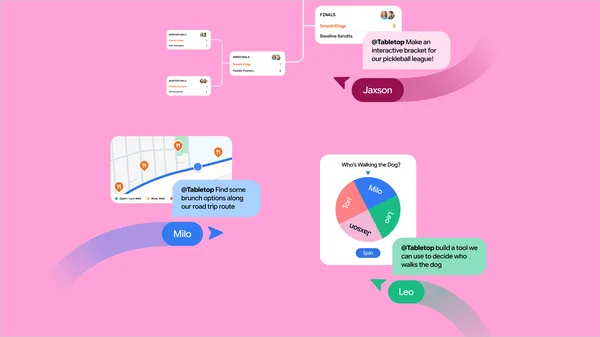
Google has unveiled "Tabletop," a new experiment emerging from Google Labs designed to redefine collaborative spaces for groups. Described as "customizable, collaborative spaces," Tabletop aims to empower teams to plan, play, and accomplish more together through interactive itineraries, polls, and even brackets. This initiative signals Google's continued exploration into innovative applications of artificial intelligence, moving beyond conventional document creation or communication tools to foster more dynamic and structured group interactions.
Industry Impact
The introduction of Google Tabletop positions itself directly in the burgeoning market of collaborative workspace platforms, currently dominated by players like Miro, Mural, and Notion. However, Tabletop's unique proposition appears to be its AI-powered, structured facilitation of group activities, rather than merely providing a blank canvas. While existing tools offer templates, Tabletop's emphasis on features like interactive itineraries and bracket generation suggests a deeper embedding of AI to guide and structure group processes. This move by Google could compel existing collaboration platforms to accelerate their own AI integration efforts, shifting from individual task assistance to actively orchestrating group dynamics. For users, it promises a potentially more intuitive and outcome-driven collaborative experience, reducing the friction often associated with unstructured brainstorming or decision-making. It underscores Google's commitment to leveraging AI not just in foundational models but also in user-facing applications that reimagine productivity.
Why It Matters
For builders and founders, Google Tabletop serves as a critical indicator of future trends in AI-powered applications. It highlights a strategic direction where AI is not merely a tool for automation or content generation, but a central orchestrator of complex human-computer and human-human interactions. The "play" aspect, alongside "plan," is particularly insightful, suggesting AI can facilitate engagement and creativity in ways traditional software cannot, by gamifying or structuring otherwise mundane group tasks. Builders should consider how their AI solutions can move beyond individual productivity to enhance collective intelligence and group outcomes. This means thinking about AI that can:
- Proactively suggest structures: AI could propose optimal workflows for specific group tasks, reducing setup time.
- Facilitate complex decision-making: Using polls, weighted criteria, or simulated outcomes within the collaborative space.
- Inject creativity and engagement: Through structured brainstorming, competitive elements like brackets, or guided ideation.
Key Takeaways
- Google Tabletop is a new AI-powered experiment from Google Labs focused on structured group collaboration.
- It aims to enhance team planning and interaction through unique features like interactive itineraries and brackets.
- The initiative signals Google's strategic push into AI-facilitated group dynamics, challenging traditional collaboration platforms.
- For founders, it emphasizes AI's role as an orchestrator of complex human-human interaction, not just an individual assistant.
- The future of collaboration may involve AI proactively guiding, structuring, and gamifying group activities for better outcomes.