
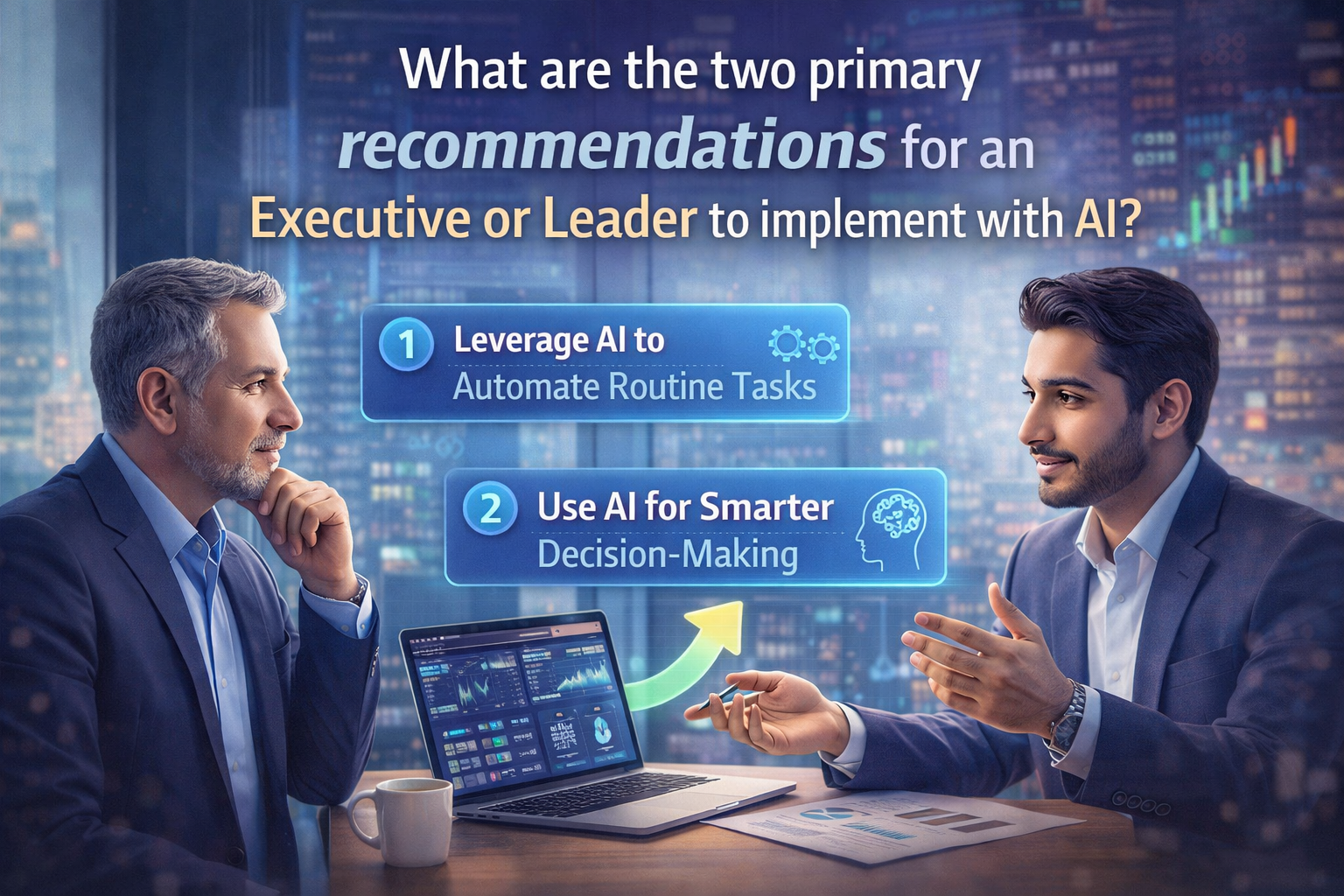
What are the two primary recommendations for an Executive or Leader to implement with AI?
Navigating the AI Frontier: Two Essential Pillars for Modern Leadership
In the rapidly evolving landscape of the 21st century, executives and leaders are no longer just managing teams; they are orchestrating a symphony of human talent and artificial intelligence. The question is no longer if AI should be implemented, but how. To lead effectively in this futuristic era, there are two primary recommendations that stand above the rest to ensure your organization remains competitive and innovative.
1. Foster an Ecosystem of 'Augmented Productivity'
The first recommendation for any leader is to move beyond seeing AI as a mere novelty and start viewing it as a core component of the operational DNA. This means implementing tools that do not just replace tasks, but augment the capabilities of the entire workforce. For instance, managing complex projects and team workflows can be drastically streamlined by using Taskade, which provides an AI-powered workspace for collective brainpower and real-time collaboration.
By automating the mundane, leaders free up their most valuable asset—their people—to focus on creative problem-solving and high-level strategy. Integration is the key to this transition. Utilizing automation platforms like Zapier allows a leader to connect disparate applications and automate cross-functional workflows without requiring a deep technical background. This creates a friction-less environment where data flows seamlessly, transforming the organization into a more agile, responsive organism.
2. Prioritize Strategic Intelligence and Brand Integrity
The second recommendation is to leverage AI for high-level decision-making while maintaining a rigorous standard for authenticity. As an executive, the quality of your insights determines the direction of the company. Implementing advanced tools like OpenAI Deep Research can help leadership teams parse through mountains of market data to find actionable trends that would otherwise take human analysts weeks to uncover.
However, with great power comes the need for great oversight. In an age of synthetic media and generated content, maintaining brand trust is paramount. Leaders must implement protocols for content verification to avoid reputational risks. Using a tool like Originality.ai ensures that the communications leaving your firm—and the data coming in—maintain the high standards of integrity your stakeholders expect. Furthermore, when it comes to communicating these high-level strategies to the board, leveraging Beautiful.ai ensures that the visual delivery of your vision is as sophisticated and professional as the technology driving it.
Conclusion: The Proactive Leader
AI implementation is not a one-time event but a continuous journey of adaptation. By focusing on augmented productivity and strategic integrity, leaders can ensure their organizations don't just survive the AI revolution, but lead it. The future belongs to those who can bridge the gap between human intuition and machine precision.