
The Three Stages of AI Evolution Based on Capability
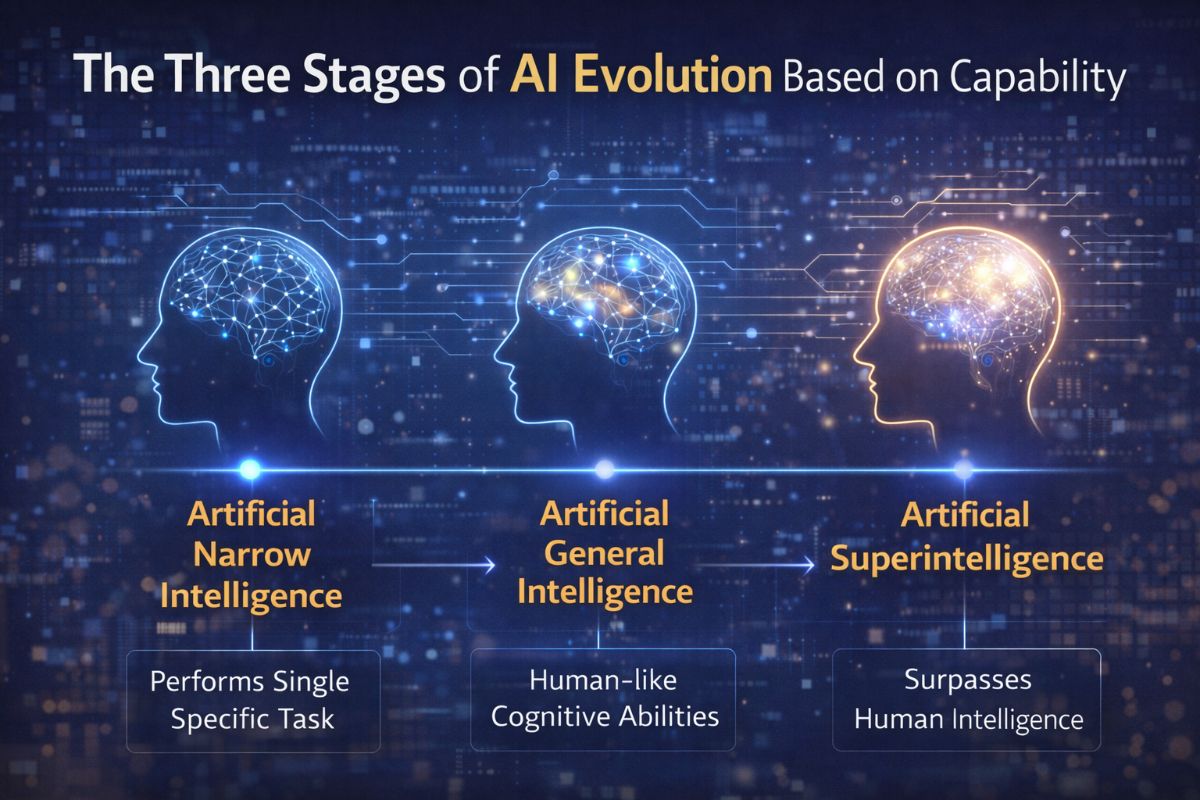
Understanding the Spectrum: The Three Stages of AI Evolution
The global artificial intelligence market is no longer a niche sector of computer science; it is a burgeoning industrial revolution. With the market valuation projected to reach $826 billion by 2030 according to Statista, understanding the taxonomy of AI is essential for any technical leader or enthusiast. AI is generally categorized into three distinct stages based on its capabilities: Artificial Narrow Intelligence (ANI), Artificial General Intelligence (AGI), and Artificial Super Intelligence (ASI).
Currently, we live in the era of ANI, but the horizon is shifting rapidly. With the emergence of "reasoning" models and autonomous agents, the boundary between narrow and general intelligence is becoming increasingly porous. This article explores these three categories, the data driving their growth, and the tools that define each stage.
1. Artificial Narrow Intelligence (ANI): The Era of Specialization
Artificial Narrow Intelligence, also known as "Weak AI," refers to systems designed to perform a specific task or solve a defined problem. ANI is the only form of AI that currently exists in the real world. While it may seem "weak" because it lacks human consciousness, ANI systems often outperform humans in their specific domains.
Analytical vs. Generative ANI
In the modern landscape, ANI is often split into two functional approaches:
- Analytical AI: These systems excel at processing vast datasets to find patterns or automate technical workflows. For example, GigaSpaces provides high-performance data processing for enterprise scaling, while tools like AI2SQL allow users to generate complex database queries without knowing code.
- Generative AI: This subset focuses on content creation. Models like Midjourney for image synthesis or ChatGPT for text generation are prime examples of narrow intelligence that mimics human creativity within specific modal constraints.
The effectiveness of ANI is driven by massive infrastructure. Companies like NVIDIA AI provide the hardware backbone (GPUs) and software stacks (CUDA) that allow these narrow models to process trillions of parameters. Despite their sophistication, these models cannot "think" outside their training data; an image generator cannot suddenly decide to optimize a supply chain.
2. Artificial General Intelligence (AGI): The Reasoning Frontier
AGI, often called "Strong AI," is the theoretical stage where an AI system possesses the ability to understand, learn, and apply its intelligence to any intellectual task that a human being can. Unlike ANI, AGI would exhibit cross-domain flexibility and self-awareness.
The Shift from Chat to Agency
Industry leaders like OpenAI, Anthropic, and Google DeepMind are currently in a race to achieve AGI. A major milestone toward this was the release of "reasoning" models, such as OpenAI's o1 series and OpenAI Deep Research, which use chain-of-thought processing to solve complex STEM problems.
Key indicators that we are approaching AGI include:
- Autonomous Problem Solving: Tools like Devin by Cognition, the world’s first AI software engineer, demonstrate the transition from simple assistants to autonomous agents that can plan and execute multi-step engineering tasks.
- Multi-Modal Mastery: Large Language Models (LLMs) like Claude and Google Gemini can now process audio, video, and text simultaneously, moving closer to the holistic sensory integration humans possess.
Experts are divided on the timeline for AGI. While some predict it by 2030, others argue that significant breakthroughs in energy efficiency and algorithmic architecture are still required to replicate the human brain's 20-watt efficiency.
3. Artificial Super Intelligence (ASI): Beyond Human Comprehension
Artificial Super Intelligence represents a hypothetical future where AI surpasses human intelligence across every field, including social skills, general wisdom, and scientific creativity. ASI would not just be faster than a human; it would be capable of cognitive feats that are currently inconceivable to us.
The Singularity and Alignment
The concept of ASI is often linked to the "Intelligence Explosion," where an AGI begins to iteratively improve its own source code, leading to an exponential increase in capability. This leads to the critical field of AI Alignment—ensuring that a super-intelligent entity maintains goals that are beneficial to humanity.
While we do not yet have tools for ASI, the research and benchmarking tools we use today, such as Artificial Analysis, are vital for tracking the accelerating pace of model performance. As models become more capable, the focus shifts from "how do we build it" to "how do we control it."
Conclusion: Navigating the AI Roadmap
Understanding these three categories helps businesses and developers distinguish between marketing hype and technical reality. Today, we leverage ANI tools like AskYourDatabase or Copy.ai to drive immediate ROI. Simultaneously, we watch the rapid ascent toward AGI with cautious optimism.
Whether we are five years or fifty years away from the next stage, the core strategy remains the same: adopt narrow AI to solve today's problems, while building the infrastructure and ethical frameworks necessary for the general and super-intelligent systems of tomorrow.