
Robotics and AI: The journey and evolution
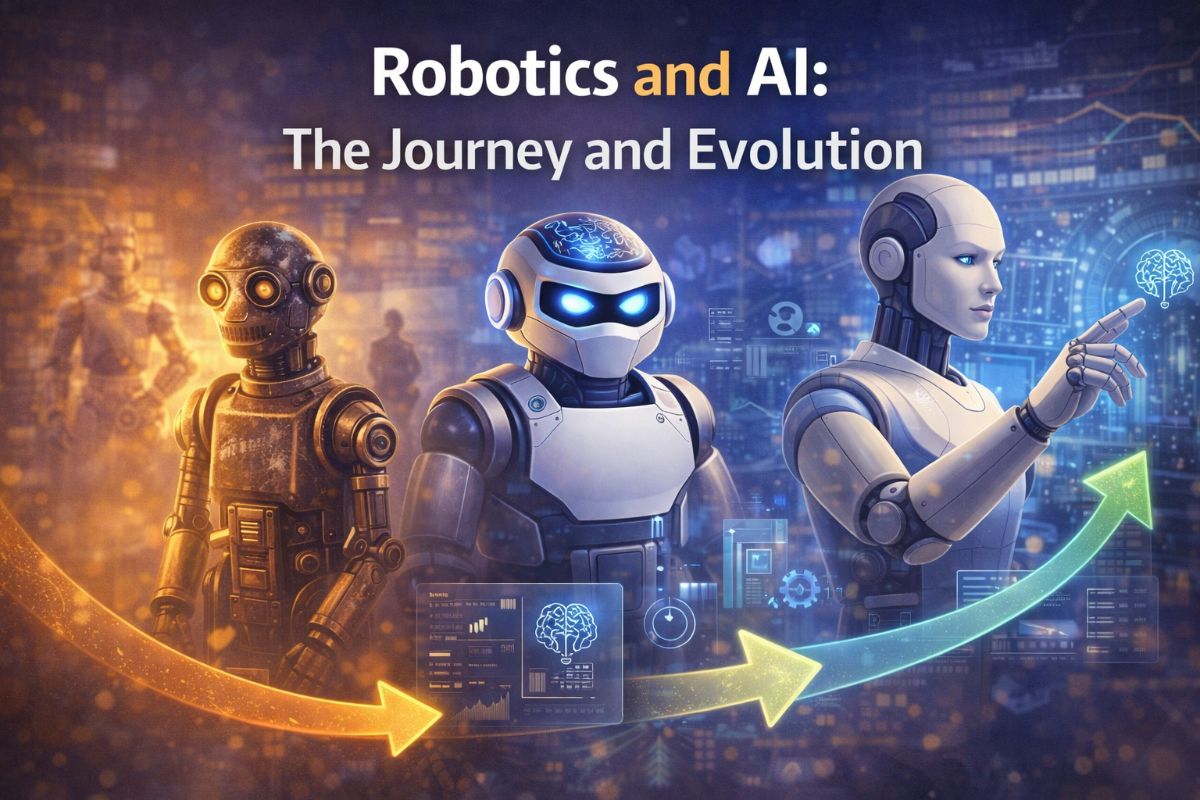
Robotics and AI: The Journey and Evolution
For decades, the fields of robotics and Artificial Intelligence (AI) moved along parallel but distinct paths. Robotics was primarily concerned with actuation, mechanics, and control loops, while AI focused on logic, pattern recognition, and data processing. Today, these paths have converged to create a new era of "embodied AI," where the digital brain and the physical body work in a seamless loop. This evolution is transforming everything from the factory floor to the furthest reaches of space.
The Era of Scripted Precision
In the early days of industrial robotics, machines were "dumb." They followed rigid, pre-programmed scripts to perform repetitive tasks with high precision. These systems lacked the ability to perceive or adapt to changes in their environment. If a part on a conveyor belt moved by two inches, the robot would continue its motion, striking empty air. The intelligence resided entirely in the human programmer, not the machine.
The first significant shift occurred with the introduction of Computer Vision (CV). By integrating cameras and sensors, robots began to "see." Early vision systems relied on analytical AI, which used mathematical models to identify shapes. However, as the global robotics market scales—projected to grow from $46 billion in 2023 to over $280 billion by 2032—the demand for more flexible, self-learning systems has driven the shift toward deep learning.
The Generative Shift: 3D Intelligence and World Models
We are currently witnessing a monumental leap: the transition from robots that simply recognize objects to robots that understand spatial context and physics. This is where generative AI and 3D modeling tools are playing a pivotal role. For a robot to navigate a complex environment, it needs high-fidelity simulations for "Sim-to-Real" training.
- Spatial Intelligence: New ventures like World Labs are pioneering "Large World Models" that give AI an inherent understanding of the 3D world, similar to human intuition.
- Asset Generation: Creating realistic training environments once took months. Now, tools like Meshy AI and GET3D allow developers to generate 3D assets from text or 2D images, drastically accelerating the simulation phase.
- Visual Realism: For robots trained on visual data, photorealistic textures generated by solutions like Luma Genie ensure that the transition from a virtual simulation to the messy, unpredictable real world is seamless.
Reasoning and Communication: The Role of LLMs
One of the biggest hurdles in robotics has been the interface. How do we tell a robot to "clean up the spill in the kitchen" without writing 10,000 lines of code? The answer lies in Large Language Models (LLMs). By using models such as Claude or Google Gemini, robots can now translate natural language instructions into a sequence of actionable steps.
This "reasoning layer" allows robots to handle ambiguity. If you tell a robot to "find something to write with," it can use the semantic reasoning capabilities of an LLM to identify that a pen, a pencil, or even a marker fits the criteria, rather than searching for a specific pre-programmed object ID.
The Infrastructure of Modern Robotics
The evolution of robotics is also a story of data management. A single autonomous robot can generate terabytes of sensor data daily. Processing this information requires robust infrastructure. Many modern robotic stacks leverage NVIDIA AI for GPU-accelerated computing and Databricks for managing the massive datasets required for reinforcement learning.
For real-time operational needs, low-latency data processing is non-negotiable. Platforms like GigaSpaces provide the high-throughput, low-latency data fabric necessary for fleets of robots to communicate and coordinate in real-time, preventing collisions and optimizing warehouse workflows.
Beyond Earth: Robotics in the Final Frontier
The most extreme test of AI-driven robotics is occurring in space. Without the luxury of real-time human intervention due to signal latency, space-bound robots must be entirely autonomous. Companies like Astroscale are utilizing AI to navigate the hazardous environment of orbital debris, while others rely on IBM Watson for advanced analytics and edge computing in satellite deployments.
The Future: Humanoids and General Purpose Robots
The "Holy Grail" of this evolution is the general-purpose humanoid robot. Unlike specialized robotic arms, humanoids are designed to operate in environments built for humans. This requires a fusion of every AI breakthrough we’ve seen: Generative AI for movement, LLMs for interaction, and Computer Vision for navigation.
As we look forward, the democratization of these tools means that even smaller startups can compete. Whether it's using OpenAI Playground to prototype a robot's conversational interface or leveraging Hugging Face to find the latest pre-trained vision models, the barrier to entry in robotics is falling. The journey from scripted machines to autonomous partners is nearing its destination, and the implications for human productivity are profound.