
Engineering Applications of Artificial Intelligence
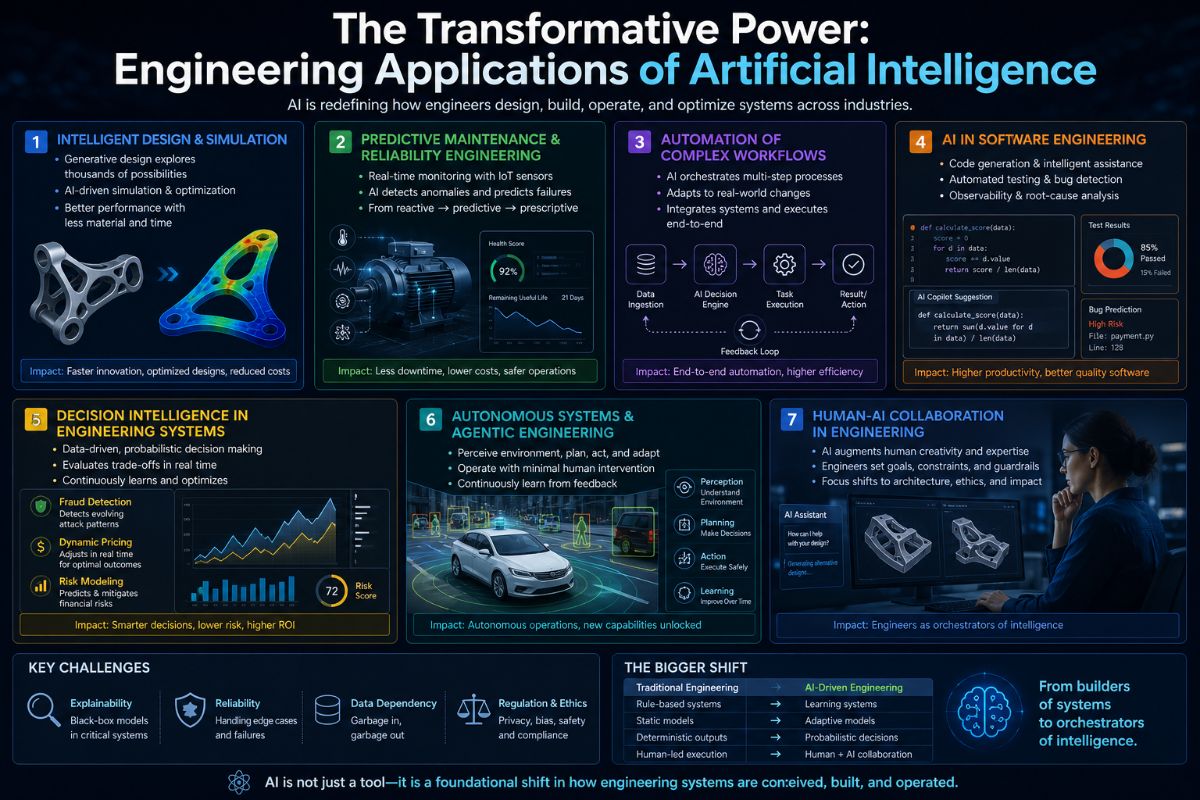
The Transformative Power: Engineering Applications of Artificial Intelligence
Artificial Intelligence (AI) is no longer a futuristic concept but a vital tool revolutionizing every facet of engineering. From the initial spark of design to complex manufacturing processes, predictive maintenance, and even the discovery of novel materials, AI is enhancing efficiency, driving innovation, and solving challenges previously deemed insurmountable. This blog post explores the diverse and impactful engineering applications of AI, highlighting key areas where this technology is making a significant difference.
Redefining Design and Prototyping
In the realm of design, AI accelerates the ideation and prototyping phases. Generative design algorithms can explore millions of design permutations, optimizing for specific criteria like weight, strength, or cost, far quicker than human engineers alone. Tools that leverage AI for 3D model generation, such as GET3D and Real Life 3D, empower engineers to rapidly visualize and iterate on complex designs. Similarly, platforms like Meshy AI are pushing the boundaries of creating intricate digital assets with AI assistance, making advanced prototyping more accessible.
Intelligent Manufacturing and Robotics
AI is at the core of the smart factory revolution. In manufacturing, AI-powered systems can predict equipment failures, optimize production schedules, and enhance quality control with unprecedented precision. For instance, robotics integrated with AI, utilizing tools like Kinetix and Rokoko Vision for motion capture and animation, are leading to more agile and efficient assembly lines. AI-driven predictive maintenance significantly reduces downtime and operational costs by identifying potential issues before they escalate. This level of automation and insight is transforming traditional manufacturing into highly responsive and adaptive ecosystems.
Accelerated Materials Discovery and Science
One of the most exciting applications of AI in engineering lies in materials science. AI algorithms can analyze vast datasets of material properties, predict behaviors, and even suggest new material compositions with desired characteristics. IBM Research, for example, is actively engaged in "Accelerated Discovery" and "Physical Sciences" initiatives, leveraging AI to speed up the discovery and development of new materials. This drastically cuts down the time and resources traditionally required for R&D. Tools that help process and analyze complex scientific data, such as Wolfram|Alpha, become even more powerful when combined with AI-driven predictive models.
Advancements in Aerospace and Space Engineering
The aerospace sector is harnessing AI for everything from optimizing aircraft design for fuel efficiency to advanced navigation systems and space exploration. AI plays a critical role in satellite deployment and maintenance, as seen with companies like Astroscale, which focuses on orbital debris removal. For deeper space exploration, platforms like Blue Origin’s OrbitalAI and the NASA Exoplanet Catalog (ExoMiner) utilize AI to analyze astronomical data and identify exoplanets. Even earth observation, through tools like Planet Labs AI Imagery Platform, benefits from AI for processing and interpreting vast amounts of satellite imagery for environmental monitoring and urban planning.
Smart Infrastructure and Civil Engineering
Civil engineering is also undergoing an AI-driven transformation. AI contributes to the design of smart cities, optimizing traffic flow, energy consumption, and waste management. In construction, AI can monitor project progress, identify safety hazards, and predict potential delays, making construction sites safer and more efficient. Platforms like OpenSpace leverage AI for 360-degree photo documentation and site analysis, providing valuable insights for project management and quality assurance.
Revolutionizing Software Engineering
Software engineering, the very foundation of AI, is also being revolutionized by its own creations. AI-powered tools are assisting developers in writing cleaner code, automating testing, and improving project management. Solutions like Devin by Cognition and CodeMender can generate code, debug, and refactor, significantly accelerating development cycles. Tools such as bugfree.ai utilize AI to identify and even suggest fixes for vulnerabilities, enhancing software reliability and security. For collaborative project management and workflow optimization, platforms like Qatalog by ClickUp and ClickUp integrate AI to streamline tasks and improve team productivity.
The Future of Engineering with AI
The integration of AI into engineering disciplines is only just beginning. As AI technologies continue to advance, we can anticipate even more profound impacts, leading to smarter systems, more efficient processes, and groundbreaking innovations across all engineering fields. The continuous development of AI models and tools, supported by platforms like Google AI Studio and OpenAI Playground, ensures that engineers have access to cutting-edge capabilities to push the boundaries of what's possible.