Building AI Agents with Python
Building AI Agents with Python
The landscape of artificial intelligence is rapidly evolving, with AI agents emerging as a transformative force. These intelligent entities, capable of perceiving their environment, making decisions, and taking actions to achieve specific goals, are moving beyond static models to dynamic, autonomous systems. Python, with its rich ecosystem of libraries and frameworks, has become the de facto language for developing these sophisticated agents. At AI Tool Hub, we're keenly observing and participating in this revolution, providing insights into how developers can harness Python to build the next generation of AI.
What are AI Agents?
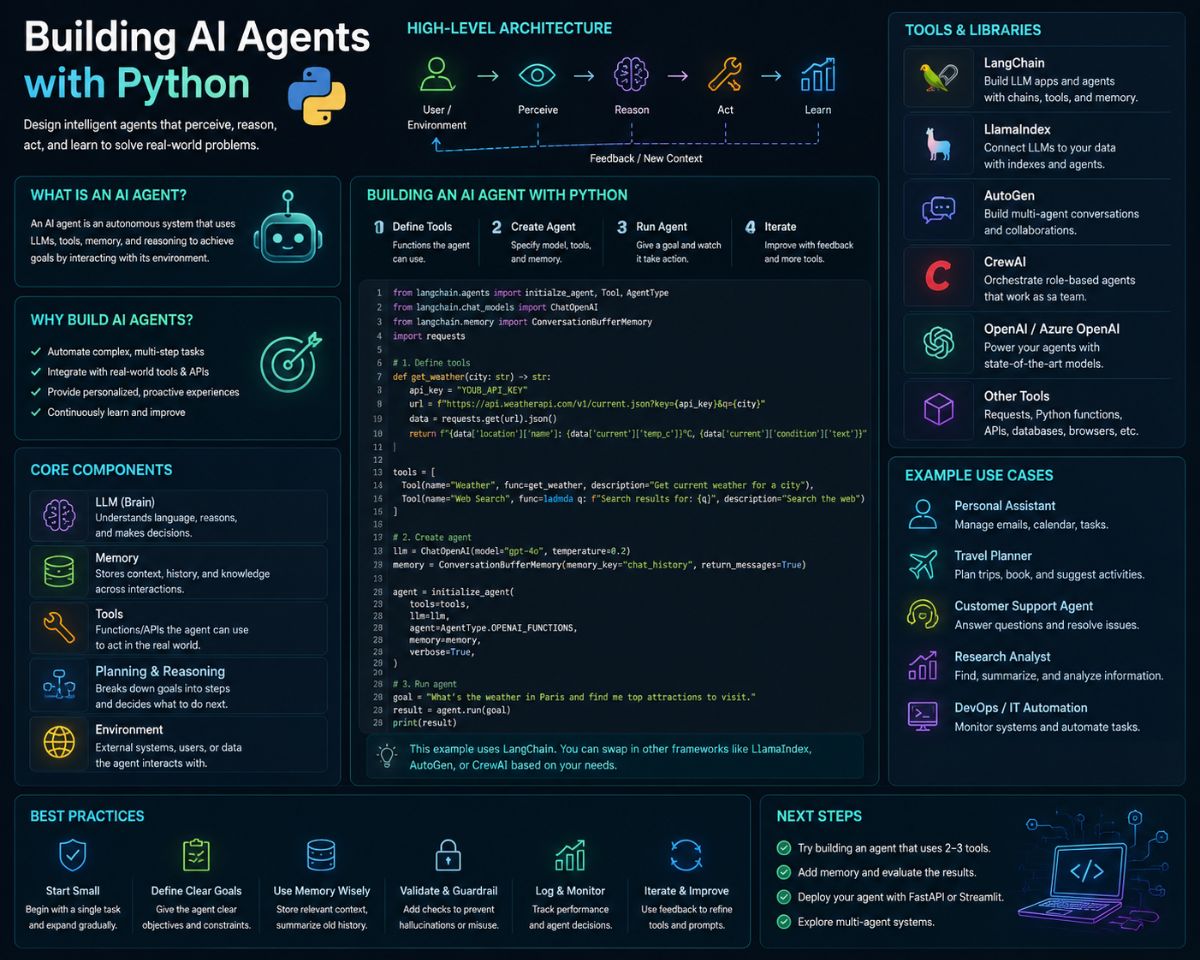
At its core, an AI agent is a program that acts autonomously to achieve a desired outcome. Think of it as a digital assistant that doesn't just respond to commands but proactively understands, plans, and executes tasks. The fundamental architecture of an AI agent often includes:
- Perception: Gathering information from the environment (e.g., reading documents, analyzing images, interpreting natural language).
- Cognition/Reasoning: Processing perceived information, making decisions, and formulating plans.
- Action: Executing tasks based on decisions (e.g., generating code, writing content, interacting with web services).
- Memory: Storing past experiences and knowledge to improve future performance.
Why Python for AI Agents?
Python's appeal for AI agent development stems from several key advantages:
- Extensive Libraries: Libraries like TensorFlow, PyTorch, and scikit-learn provide powerful tools for machine learning and deep learning, crucial for an agent's perception and cognition.
- Readability and Simplicity: Python's syntax allows for rapid prototyping and development, enabling developers to quickly iterate on agent designs.
- Vast Community Support: A large and active community contributes to a wealth of resources, tutorials, and open-source projects.
- Integration Capabilities: Python easily integrates with various APIs and external services, essential for agents to interact with the real world.
Key Components and Python Implementations
1. Large Language Models (LLMs) as the Agent's Brain
LLMs are often the central intelligence of an AI agent, providing the reasoning and natural language understanding capabilities. Frameworks like Google's Google Gemini and Claude by Anthropic, or even leveraging OpenAI's models, are pivotal. These models allow agents to understand complex instructions, generate human-like text, and even plan multi-step actions.
2. Tool Use and External Interactions
For agents to be truly effective, they need to interact with external tools and services. Python facilitates this through API integrations. For example, an agent might use a tool like Zapier or n8n for connecting to various web applications, or specific tools for content generation like Wan Animate for video creation, Qwen Image Edit for image manipulation, or even Beatoven.ai for custom music generation. These integrations empower agents to perform tasks far beyond simple text generation.
3. Memory and State Management
Maintaining a coherent state and memory is crucial for agents to learn and adapt over time. This can range from simple contextual memory within a conversation to long-term knowledge bases. Python offers various database connectors and data structures to manage this, allowing agents to remember past interactions and use that information in future decision-making.
4. Orchestration and Multi-Agent Systems
The rise of frameworks like Microsoft AutoGen and CAMEL-AI showcases the growing interest in orchestrating multiple AI agents to work collaboratively. Python provides the flexibility to build such complex systems, where different agents specialize in different tasks, leading to more robust and capable solutions. For instance, one agent might be responsible for data extraction using tools like Browse AI, while another processes that data, and a third generates reports using a tool like MyReport AI.
Real-World Applications and AI Tool Hub Integrations
AI agents built with Python are finding applications across numerous industries:
- Automated Content Creation: Agents can draft blog posts, social media updates, or even generate video scripts. Tools like Writesonic or Copy.ai can be integrated for powerful content generation.
- Customer Service Automation: Advanced chatbots and virtual assistants can handle complex queries, manage bookings, and provide personalized support. Platforms like Botpress facilitate building such agents.
- Data Analysis and Research: Agents can scour vast datasets, summarize research papers (Scholarcy), and identify trends, proving invaluable for financial analysis or scientific discovery. Tools like Julius AI can assist with data analysis and visualization.
- Workflow Automation: Automating repetitive tasks across various software applications, from managing emails to orchestrating complex project workflows with tools like Grok Automation or Workforce Wave.
- Personalized Learning: AI agents can adapt educational content and provide personalized feedback, enhancing the learning experience. Tools like StudyX and TeachQuill are examples in this space.
The Future of AI Agents with Python
The trajectory of AI agent development points towards increasingly sophisticated, adaptable, and collaborative systems. Python will continue to be at the forefront, providing the flexibility and power needed to innovate. As LLMs become more capable and specialized tools emerge, we'll see agents that can handle more nuanced tasks, operate in less structured environments, and truly augment human capabilities in unprecedented ways. The integration of advanced visual and audio processing capabilities, perhaps through tools like VibeVoice or Replaci Vision, will further expand the sensory input and output for these agents.
The journey of building AI agents with Python is an exciting one, full of potential for groundbreaking applications. Stay tuned to AI Tool Hub for more updates and resources as this field continues to advance!