Beyond 10x Engineers: Designing AI-Native Teams Around Context
The Evolution of the 10x Engineer
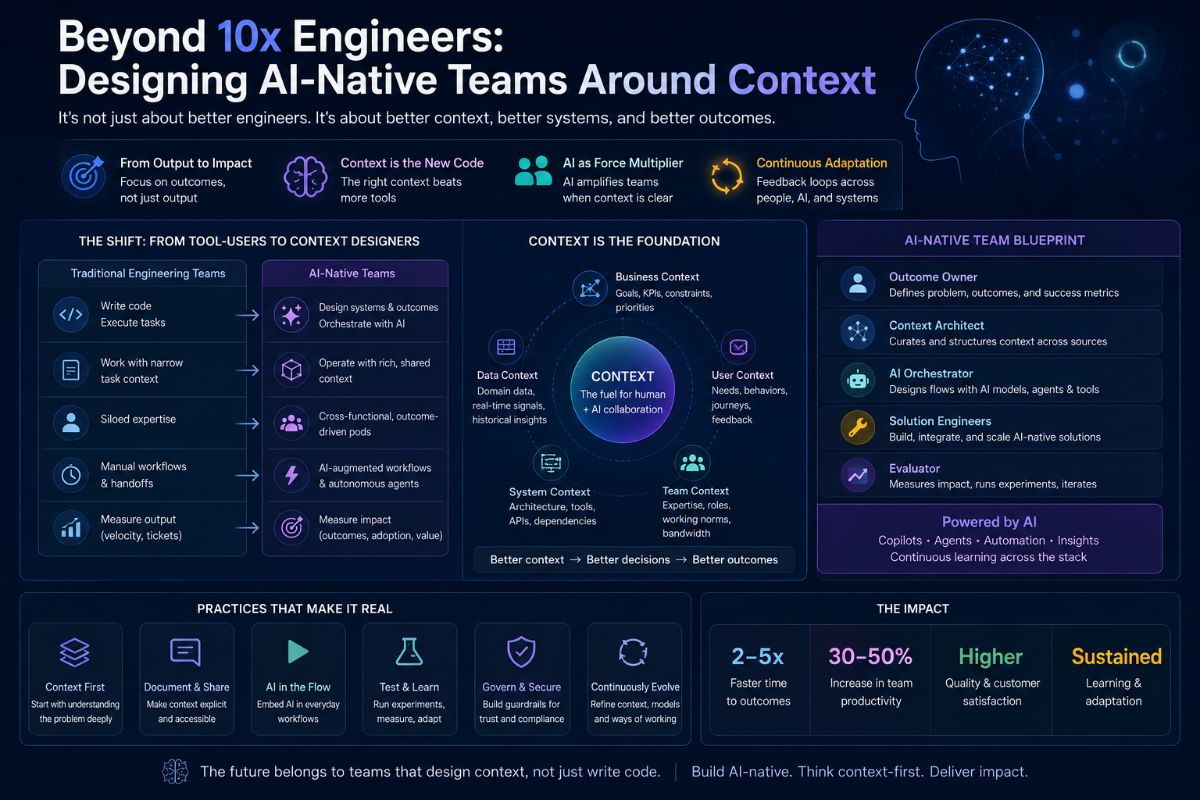
For decades, the tech industry has chased the legendary "10x engineer"—that rare individual who performs at an order of magnitude higher than their peers. But in the era of generative AI, the bottleneck is no longer how fast one can write code or generate assets. The new frontier is context orchestration. Designing an AI-native team means moving beyond individual brilliance and focusing on how information flows between human intuition and machine intelligence.
Building the Contextual Backbone
In a traditional team, context is trapped in Slack threads, emails, and the minds of senior leaders. An AI-native team externalizes this context so that every tool in their stack is "aware" of the project's goals. For instance, teams are increasingly using NotebookLM to ground their internal knowledge, allowing the AI to act as a living repository that understands the nuance of their specific business logic. When your documentation is interactive, your onboarding time drops from weeks to hours.
Connecting the Dots with Automation
Context is only useful if it can move. Modern teams aren't just using static software; they are building custom pipelines. By leveraging n8n, teams can create complex, context-aware workflows that bridge the gap between disparate data sources and action. This allows for a level of operational agility where the team spends less time on "work about work" and more time on high-level strategy.
The Developer Experience Redefined
The role of the engineer is shifting from manual coding to system architecture. Tools like Cursor demonstrate this shift by offering an IDE that understands the entire codebase. This enables developers to maintain a 10x pace not by typing faster, but by navigating their architectural context with AI-assisted precision. It’s about building a symbiosis where the machine handles the syntax and the human handles the semantics.
The Rise of the Agentic Team Member
We are entering an era where agents aren't just tools, but auxiliary team members. A general-purpose AI agent like Manus can handle research, multi-step planning, and execution tasks that previously required a junior staffer. Similarly, for content-focused teams, Surfer provides the SEO context necessary to ensure that every piece of content is data-backed and strategically aligned with market trends.
The Future: Teams as Orchestrators
The AI-native team of the future is small, lean, and highly leveraged. By designing around context rather than individual output, companies can achieve a 100x impact with a 10-person team. The goal is no longer to find the 10x engineer, but to build the context-rich environment that turns every team member into a 100x orchestrator.