Artificial Narrow Intelligence: The Power of Specificity
Understanding Artificial Narrow Intelligence: The Power of Specificity
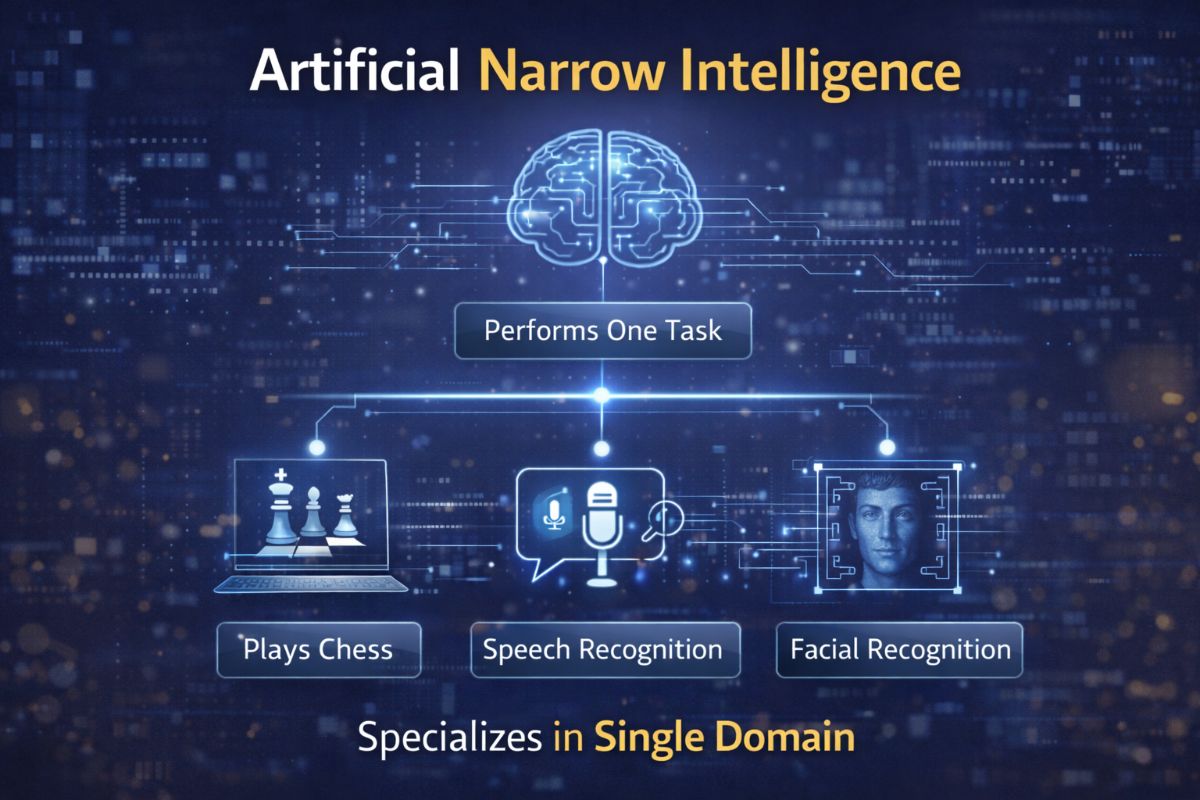
In the rapidly evolving landscape of artificial intelligence, a fundamental distinction exists between the AI of science fiction and the AI that powers our world today. When we ask "what type of AI is designed to perform a specific task without general understanding?" the technical answer is Artificial Narrow Intelligence (ANI), also commonly referred to as "Weak AI."
Unlike Artificial General Intelligence (AGI), which remains a theoretical milestone where a machine could possess the ability to understand or learn any intellectual task that a human being can, ANI is the current industrial standard. It is highly specialized, incredibly efficient, and operates within a pre-defined range of functions. According to recent market reports, the global AI market is projected to reach approximately $1.8 trillion by 2030, with the vast majority of that value driven by narrow, task-specific applications rather than general-purpose agents.
The Mechanics of Narrow AI: Performance Over Sentience
The core characteristic of ANI is its lack of general consciousness or subjective experience. For instance, a translation engine doesn't "understand" the cultural nuances of the language it processes; it identifies statistical patterns and maps tokens based on massive datasets. This focus on specific objectives allows ANI tools to outperform humans in niche domains.
- Pattern Recognition: Identifying anomalies in medical imaging or financial fraud.
- Optimization: Managing complex logistics or data pipelines using platforms like GigaSpaces.
- Natural Language Processing (NLP): Translating natural language into technical queries, as seen with specialized tools like AI2SQL or AskYourDatabase.
Specialized AI in the Enterprise: Efficiency via Constraint
In the corporate sector, the trend is moving away from "do-it-all" chatbots toward agentic workflows. These are systems where multiple ANI components work together to solve complex problems. For example, a marketing team might use Jasper for high-velocity copy generation while employing Lumen5 to turn that copy into video content. Each tool is world-class at its specific task, yet neither knows the other exists, nor do they understand the "why" behind the marketing campaign.
This "lack of understanding" is actually a feature, not a bug. It ensures predictability and safety. For developers managing massive datasets, using an integrated solution like Databricks allows for specialized machine learning models to be deployed at scale without the risk of the system "hallucinating" beyond its intended operational parameters.
The Rise of Domain-Specific Models
While Large Language Models (LLMs) like Claude or the latest releases from DeepSeek exhibit remarkable versatility, they are essentially highly advanced ANI. They simulate understanding through probabilistic inference. We are seeing a significant shift toward Domain-Specific Narrow AI, which provides deeper value in technical fields:
- Legal & Compliance: Tools like Harvey are trained specifically on legal datasets, ensuring accuracy that a general model cannot guarantee.
- Content Editing: Precision-focused tools like Grammarly focus solely on syntax and tone, rather than creative ideation.
- Advanced Research: Specialized agents like OpenAI Deep Research are designed to perform iterative, deep-dive information gathering far beyond the scope of a standard search.
Why Narrow AI is the Future of Industry
The industry is currently debating the timeline for AGI, with experts at Google DeepMind and OpenAI offering varying estimates. However, for most businesses, the immediate ROI lies in hyper-specialization. By narrowing the scope, developers can reduce the computational cost and increase the reliability of AI outputs. Tools like Synthesia for video or ElevenLabs for voice synthesis demonstrate that when AI is designed for a single modality, it can reach "human-parity" quality levels long before a general AI could.
In conclusion, while the dream of a machine that truly "understands" the world persists, the reality of the AI revolution is built on the shoulders of Narrow Intelligence. By leveraging task-specific tools, we can automate the mundane, optimize the complex, and unlock new levels of human creativity—all without the machine needing to understand a single word it says.