Artificial Intelligence in Drug Discovery
Artificial Intelligence in Drug Discovery
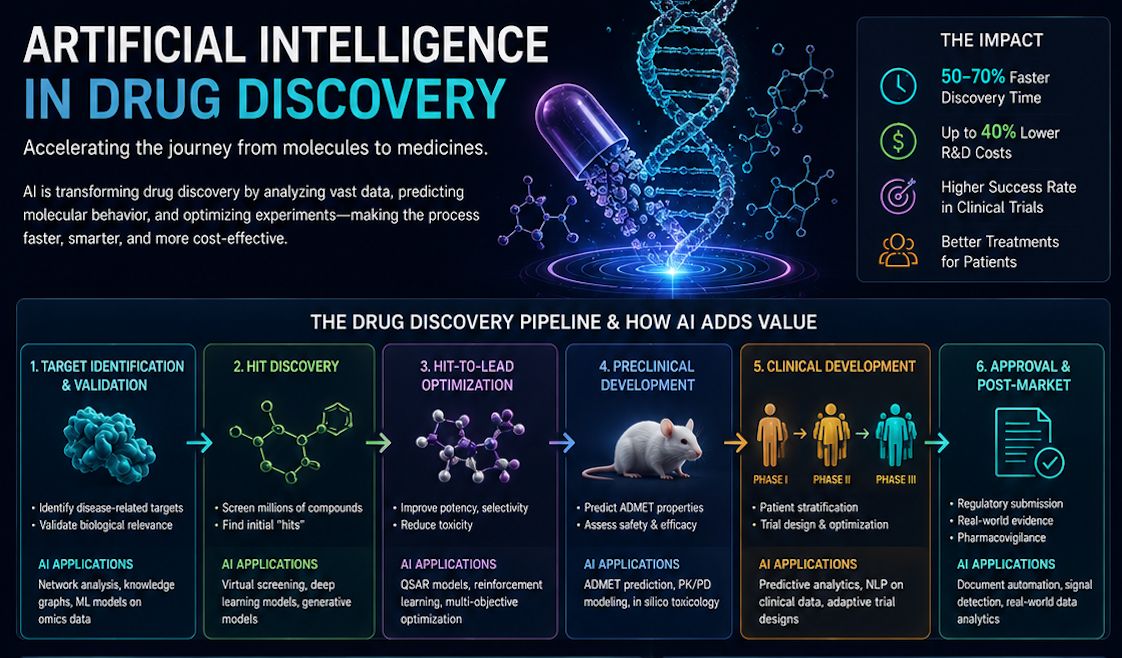
The pharmaceutical industry is at the cusp of a revolutionary transformation, driven by the burgeoning power of artificial intelligence. Traditionally, drug discovery has been a protracted, costly, and often unpredictable endeavor, spanning over a decade and costing billions of dollars. However, AI is rapidly reshaping every stage of this intricate process, from target identification to clinical trials, promising accelerated timelines, reduced costs, and a higher success rate for bringing life-saving medications to patients.
The AI Advantage: Revolutionizing Each Stage
Artificial intelligence offers unprecedented capabilities that address many of the long-standing challenges in drug discovery:
1. Target Identification and Validation
- Uncovering Novel Targets: AI algorithms can analyze vast datasets of genomic, proteomic, and clinical data to identify novel biological targets implicated in diseases. This goes beyond what human researchers can achieve, uncovering complex relationships and hidden patterns.
- Predictive Modeling: Tools like Neurohelper AI, though designed for broader applications, exemplify the analytical power AI brings to understanding complex biological systems, which is crucial for predicting the efficacy and safety of potential drug targets.
2. Drug Design and Compound Synthesis
- De Novo Drug Design: AI can design novel molecular structures with desired properties from scratch, rather than relying solely on existing compound libraries. This allows for the exploration of a far larger chemical space.
- Lead Optimization: Machine learning models predict how well a compound will bind to a target, its solubility, toxicity, and other crucial pharmacological properties, enabling rapid optimization of lead candidates.
3. Preclinical and Clinical Development
- Accelerated Preclinical Testing: AI can predict potential toxicity and adverse effects of drug candidates, reducing the need for extensive in vitro and in vivo testing. This is analogous to how tools like BkAbhi Innovations Lab foster innovation, but in a highly specialized biological context.
- Smarter Clinical Trial Design: AI helps in identifying ideal patient cohorts, predicting patient responses to therapies, and optimizing trial designs, thereby increasing the efficiency and success rates of clinical trials. The ability to process and analyze vast amounts of data is similar to what tools like Fast PDF Extractor offer for text, but applied to complex medical records and research papers.
Real-World Impact and Future Outlook
The impact of AI in drug discovery is already being felt. For example, IBM Research highlights that AI is increasingly being used to accelerate discovery, stating that "AI models are being deployed to predict drug-target interactions, identify novel drug candidates, and optimize synthesis pathways." This demonstrates a shift from traditional methods to more data-driven, intelligent approaches.
The global AI in drug discovery market is projected for significant growth, reflecting the industry's confidence in this technology. As AI models become more sophisticated and data availability increases, we can expect even more transformative breakthroughs. The integration of AI tools across various industries, from creative content generation with Seedance 2.5 AI Video Generator and getimg.ai to business solutions with HISAB 360, underscores the broad applicability and revolutionary potential of AI, with drug discovery standing as one of its most critical frontiers.
Challenges and Considerations
While the potential is immense, challenges remain. These include the need for high-quality, diverse datasets for training AI models, ensuring the interpretability of AI predictions (the 'black box' problem), and navigating regulatory frameworks that are still catching up with rapid technological advancements. Ethical considerations regarding data privacy and the responsible deployment of AI in healthcare are also paramount.
Conclusion
Artificial intelligence is not just an incremental improvement; it is a fundamental shift in how drugs are discovered and developed. By automating tedious tasks, uncovering hidden insights, and accelerating timelines, AI is paving the way for a new era of personalized medicine and more effective treatments for a wide range of diseases. The journey is complex, but with continued innovation and collaboration, AI promises to unlock unprecedented possibilities in the quest for better human health.