Agentic AI vs AI Agents
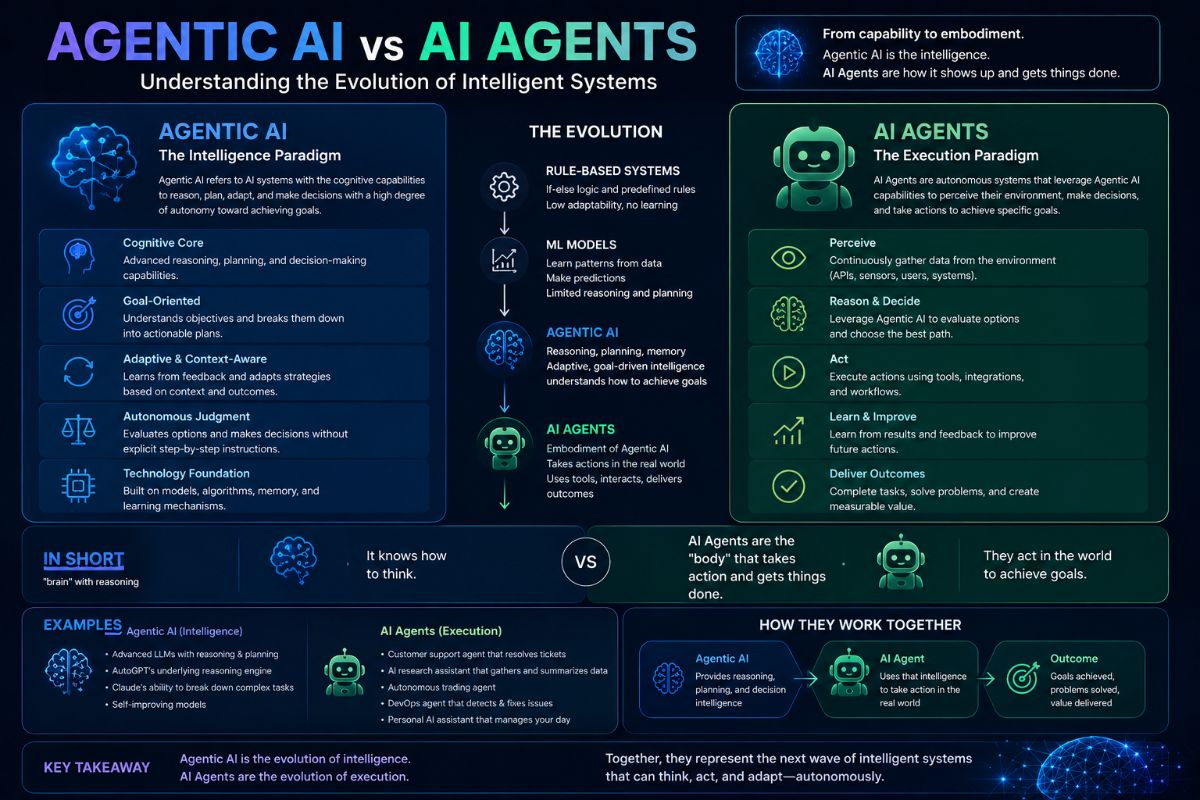
Agentic AI vs AI Agents: Understanding the Evolution of Intelligent Systems
The landscape of artificial intelligence is rapidly evolving, bringing with it sophisticated concepts and powerful applications. Among the most discussed terms currently are “Agentic AI” and “AI Agents.” While often used interchangeably, these terms represent distinct, albeit related, paradigms in the development of autonomous intelligent systems. As an AI industry analyst for "AI Tool Hub," let's dive into what sets them apart and how they are shaping the future.
What are AI Agents?
At its core, an AI Agent is a software entity designed to perceive its environment through sensors, process information, make decisions, and take actions to achieve a specific goal. Think of them as specialized digital assistants, each programmed to excel at particular tasks. They operate based on a predefined set of rules or learned behaviors. According to IBM's explanations on AI, an AI agent can range from a simple chatbot to a more complex system automating specific workflows.
- Perception: Gathering data from its environment (e.g., reading text, analyzing images, listening to audio).
- Reasoning/Decision-Making: Using algorithms or models to interpret perceptions and decide on the next steps.
- Action: Executing operations based on decisions (e.g., generating content, sending emails, updating databases).
- Goal-Oriented: Designed to achieve a specific, often singular, objective.
Examples of AI Agents in action include tools like ChatDOC for intelligent document interaction, Otter.ai for transcribing meetings, or Kling 3.0 AI Video Generator for creating video content. These tools are highly effective at their designated functions, acting as discrete agents performing defined tasks.
What is Agentic AI?
Agentic AI, on the other hand, refers to a broader, more advanced paradigm where AI systems exhibit a higher degree of autonomy, adaptability, and complex reasoning over extended periods. It's not just about an agent performing a task, but about the *agentic quality* of the AI itself – its ability to proactively define sub-goals, engage in self-reflection, adapt to dynamic environments, and even learn from its failures to achieve a high-level, often ambiguous objective. These systems typically involve multiple AI agents collaborating or a single, highly sophisticated agent with advanced planning capabilities.
- High Autonomy: The ability to operate with minimal human intervention, making decisions and taking actions independently.
- Goal Decomposition: Breaking down complex, abstract goals into manageable sub-tasks.
- Self-Correction & Reflection: Evaluating its own performance, identifying errors, and adjusting strategies.
- Memory & Learning: Retaining information and applying past experiences to improve future performance.
- Tool Use: Dynamically selecting and utilizing various tools and APIs to accomplish tasks.
Think of frameworks like Microsoft AutoGen, which facilitates multi-agent conversations and collaborative problem-solving, or the ambition behind systems like AutoGPT and AgentGPT. These represent steps towards truly Agentic AI, where the system isn't just following instructions but actively figuring out *how* to achieve a goal, potentially across many steps and interactions. Platforms such as Workforce Wave hint at the future of integrated agentic solutions transforming entire organizational workflows.
Key Differences and Similarities
While both concepts deal with intelligent entities acting on goals, the distinction lies primarily in their level of autonomy, complexity of tasks, and adaptive capabilities:
Differences:
-
Scope of Action:
- AI Agents: Typically execute predefined, often singular tasks. Their "intelligence" is specialized.
- Agentic AI: Addresses broad, open-ended problems, dynamically creating and executing multi-step plans.
-
Autonomy & Adaptability:
- AI Agents: Often reactive or proactive within a constrained environment, with limited self-correction.
- Agentic AI: Highly autonomous, capable of self-reflection, self-correction, and adapting to novel situations.
-
Complexity of Goals:
- AI Agents: Best for well-defined, singular objectives.
- Agentic AI: Designed for ambiguous, complex objectives that require decomposition and iterative problem-solving, much like EaseMate AI aims to assist across study, work, and creativity.
Similarities:
- Goal-Oriented: Both are designed to achieve specific outcomes.
- Perception-Action Loop: Both observe their environment and take actions based on those observations.
- Leverage AI Models: Both rely on underlying AI models (LLMs, vision models, etc.) to perform their functions. Even robust platforms like IBM Watson and Google DeepMind contribute to the building blocks of both.
The Future: Convergence and Collaboration
The distinction between Agentic AI and AI Agents is less about a rigid divide and more about a spectrum of capabilities. Simple AI Agents are often the building blocks within larger, more sophisticated Agentic AI systems. The trend is towards creating more autonomous and intelligent systems that can orchestrate multiple agents or perform complex tasks with minimal oversight.
As AI continues to advance, we'll see more tools incorporating agentic principles. For instance, an agent designed for content generation, like Video To Blog, might evolve to not just transcribe and summarize, but also research related topics, optimize for SEO, and even publish the content – exhibiting a more agentic workflow. The future holds immense potential for these intelligent systems to redefine productivity and innovation across industries.
Conclusion
Understanding the difference between AI Agents and Agentic AI is crucial for navigating the evolving AI landscape. While AI Agents are specialized tools for specific tasks, Agentic AI represents a grander vision of autonomous, self-improving systems capable of tackling complex, multi-faceted problems. As these technologies mature, they promise to unlock unprecedented levels of efficiency, creativity, and problem-solving capabilities.